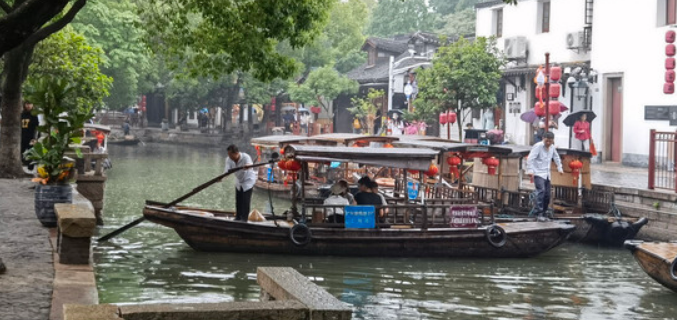
This guide is tailored for foreign travelers who want to explore the essence of Jiangsu, Shanghai and Zhejiang in 4 days, focusing on accessible attractions, key highlights and practical tips.
Basic Info Duration: 4 days Budget per person: ~1,000 RMB (excluding international flights) Best Time: May (mild weather, less crowds) Suitable for: Foreign travelers interested in Chinese history, ancient towns and natural scenery
Day 1: Zhenjiang & Suzhou
Morning: Beigu Mountain (Zhenjiang)
One of Zhenjiang’s three famous mountains, beside the Yangtze River, with a history tied to the Three Kingdoms period.
Must-See: Ganlu Temple (top of the mountain, "temple crowning the mountain" style), Henshi Stone, Jijiang Pavilion, Iron Pagoda (rare ancient iron structure in China).
Tips: Wear comfortable shoes for mountain climbing; English signs are available at key spots.
Afternoon: Jinxi Ancient Town (Suzhou)
A 2,000-year-old Jiangnan water town, known as "Hometown of Chinese Folk Museums".
Must-See: 36 ancient bridges, waterside streets with blue-tiled white houses, Tongshen Imperial Academy, Chenfei Water Tomb.
Tips: Take a boat tour (50-80 RMB/person) to experience the water town charm; try local snacks like glutinous rice cakes.
Day 2: Zhujiajiao Ancient Town (Shanghai)
Shanghai’s largest ancient town, at the junction of Jiangsu, Shanghai and Zhejiang, with a history of over 800 years.
Must-See: Fangsheng Bridge (Shanghai’s largest five-arch stone bridge), North Street (leisure street with local shops), Daqing Post Office (ancient post office).
Tips: Easy to reach by subway from downtown Shanghai (Line 17 to Zhujiajiao Station); spend 3-4 hours here, then head to downtown Shanghai for dinner.
Day 3: Tianmu Mountain (Zhejiang)
Nicknamed "Kingdom of Giant Trees" and "Cool World", a UNESCO World Biosphere Reserve with rich natural and cultural heritage.
Must-See: 12,000-year-old ginkgo tree ("Ancestor of Ginkgoes"), Big Tree King, Chanyuan Temple (famous Buddhist temple).
Tips: The mountain is cool; bring a light jacket. Hiking trails are well-paved; English brochures are available at the visitor center.
Day 4: Maoshan (Zhenjiang & Changzhou)
Taoism’s No.1 Blessed Land, birthplace of the Shangqing School of Taoism, with unique cultural relics and red tourism sites.
Must-See: Maoshan New Fourth Army Memorial Hall, Monument to the Victory of the Southern Jiangsu Anti-Japanese War, Jiuxiao Wanfu Palace (home to Maoshan’s four national treasures).
Tips: Arrange a local guide if you want to learn more about Taoist culture; the four national treasures are only displayed to visitors with prior arrangement.
Practical Tips for Foreign Travelers
-
Transport: High-speed trains connect all cities (book tickets via 12306 app or ticket offices; show passport when buying).
-
Payment: Alipay/WeChat Pay are widely accepted; link your foreign credit card in advance.
-
Language: Most scenic spots have English signs; carry a translation app (like WeChat Translate) for communication.
-
Accommodation: Book hotels near subway stations or scenic spots for convenience; international hotels are available in major cities.