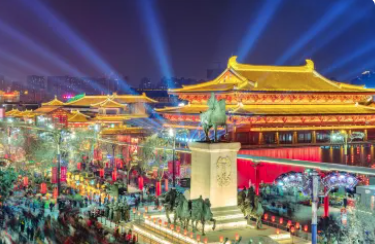
I stood barefoot on the 1,300-year-old bricks of the Ming Dynasty City Wall, wind whipping my hair, Tang dynasty poetry echoing in my headphones—and then my phone died. 🔋💥
No Google Maps. No translation app.
Just me, a confused street vendor selling roujiamo, and a sudden, dizzying realization:
I’m not in Ohio anymore.
Xi’an isn’t just “old.”
It’s palpably ancient—like walking into a history textbook that breathes, smells of cumin and wet clay, and occasionally yells at you for taking selfies with a terracotta warrior’s left foot. 😅
This is where China began—not as a nation, but as an idea:
silk, bronze, ink, rebellion, poetry, and so much wheat.
Where Confucius’ disciples debated under gingko trees… while modern college kids livestreamed dumpling-making from the same alley.
I came expecting ruins.
I left clutching a hand-stitched hua bao (peony pouch), arguing with a noodle master over the exact millisecond to pull biangbiang mian, and crying—genuinely—when an 82-year-old calligrapher pressed a brush into my palm and said,
“Your hand shakes? Good. That means your heart is awake.”
Yeah. Xi’an hits different.
🌞 Best Time to Visit
Spring (March–May) and autumn (September–October) are golden—literally.
Temperatures hover between 12°C–25°C (54°F–77°F), skies stay clear, and the city’s 3,000+ ginkgo trees turn the ancient alleys into molten gold tunnels. 💛
Summer? Brutal.
Humidity clings like cling wrap. July highs often hit 37°C (99°F)—and yes, the Terracotta Army pits feel like steam rooms. 🔥
Winter’s crisp and quiet, but bone-chilling (down to -5°C / 23°F), with frequent haze that turns the Big Wild Goose Pagoda into a ghostly silhouette.
Pro tip: Avoid Chinese National Day week (Oct 1–7).
Crowds swell to “you-can’t-breathe-unless-you-scream-into-a-bag” levels.
I got stuck behind 47 tour groups in one 200-meter stretch near the Muslim Quarter. 😤
🚆 How to Get There
Xi’an Xianyang International Airport (XIY) is your main gateway—about 40 km northwest of downtown.
- Take the Airport Intercity Railway: ¥16, 30 mins to North Railway Station
Smooth, clean, and shockingly punctual.
- Or grab a Didi: ¥120–150
But drivers will try to convince you their cousin owns a “very authentic” Tang-dynasty teahouse. 🙃
Coming from Beijing or Shanghai?
High-speed rail is mind-blowing.
G-trains arrive in ~4–5 hours (¥515–580), gliding past loess plateaus like painted movie backdrops.
Book via Trip.com or 12306.
Fair warning: 12306 requires strict real-name verification — passport photo + selfie holding it.
I failed three times before learning it needed to be exactly 35mm × 45mm. Not close. Exactly. 😩
Buses? Only if you love adventure, questionable upholstery, and impromptu karaoke stops.
🏛️ Must-See Sights
The Terracotta Army
(Emperor Qinshihuang’s Mausoleum Site Museum)
Three pits. Over 8,000 life-size warriors. Buried for 2,200 years.
Zero of them look bored—even though they’ve been standing there since before Julius Caesar. 😅
Why it stuns:
Pit 1 is pure theater — rows of generals, archers, cavalry, each with unique faces, hairstyles, even fingerprints carved by unknown artisans.
You’ll whisper. You’ll step back. You’ll forget to blink.
Tips:
- Buy tickets online: ¥120 (includes shuttle bus)
- Arrive at 8:30 a.m. — first hour is almost crowd-free
- Skip the “emperor’s tomb” — unexcavated, just a grassy hill with a “Don’t dig” sign
My moment:
I cried not from awe, but because the audio guide said:
“This general’s left eyebrow chipped in 1974. A restorer spent 11 months fixing one fragment.”
My disposable coffee cup suddenly felt very small. ☕
Xi’an City Wall (Ming Dynasty, 1370 CE)
The largest, most intact ancient city wall in China:
13.7 km around, 12 m high, four grand gates, and actual old cannons still mounted.
Rent a bike (¥45/day) and pedal clockwise — locals say it brings luck.
I did it. My knees hated me.
Why it sings:
At sunset, gray bricks turn honey-gold.
You pass watchtowers where Ming soldiers lit signal fires… now teens sip bubble tea and film TikTok dances.
Time travel, literally.
Tips:
- Enter at South Gate (Yongning Men) — most dramatic, with drawbridges and drum towers
- Walk 200m east for cheaper, better bike rentals; avoid gate-side scammers
My rant:
One rental guy claimed my helmet “wasn’t spiritually aligned.”
I gave him ¥5 and left. He yelled “Your chi will scatter!”
My chi definitely scattered when I hit a pothole. 💀
Muslim Quarter (Huimin Jie & Daxi Alley)
Not just a “quarter” — a living, sizzling artery of Hui, Uyghur, and Han culture.
Narrow lanes, red lanterns, the smell of cumin everywhere, lamb fat crackling, grandmas slapping dough into roujiamo like it’s a martial art.
Why it’s magic:
This isn’t museum-history. It’s lived-in.
Locals shop, chat, argue, cook, and laugh right beside tourists.
You don’t just watch culture here — you taste it, hear it, bump into it.
Must-do here:
- Stuff your face with roujiamo (Chinese hamburger)
- Try yangrou chuan — cumin lamb skewers
- Sip sweet pear soup to cool down
- Wander deep into side alleys; the further you go, the more authentic and cheap it gets
Warning:
Main lanes get packed after 6 PM. Go early to eat like a local, not a tourist.
Big Wild Goose Pagoda & Tang Paradise
One of Xi’an’s most iconic symbols, built during the Tang Dynasty for Buddhist scriptures.
The pagoda itself is simple, sturdy, and full of calm energy.
Around it, parks, tea houses, and slow-walking locals make it perfect for a relaxed afternoon.
Pro move:
Skip the overpriced Tang Paradise theme park.
Just sit near the pagoda, watch locals practice tai chi, and let the ancient vibe sink in.
Shuyuan Gate Cultural Street
Calligraphy, ink paintings, traditional scrolls, jade, and hand-sewn crafts.
Elderly artists sit on stools writing characters for tourists, and the whole street smells like ink and paper.
This is where I met that 82-year-old calligrapher.
If you’re lucky, someone might hand you a brush and let you try.
Don’t worry about being bad — they love the effort.
🍜 What to Eat in Xi’an (No Tourist Regrets)
Xi’an is wheat-country — noodles, bread, and dumplings dominate.
- Roujiamo: The original “Chinese hamburger” — slow-cooked pork in crispy bun
- Biangbiang Mian: Wide, hand-pulled noodles so big they have their own complex Chinese character
- Lamb Skewers (Yangrou Chuan): Cumin + chili + juicy lamb = street-food perfection
- Cold Skin Noodles (Liangpi): Spicy, tangy, refreshing — summer in a bowl
- Persimmon Cakes: Sweet, soft, fried local snack
- Sour Plum Soup: The perfect cooling drink after spicy food
Rule of thumb:
If it’s crowded with locals, it’s good.
If it’s empty and only tourists, run.
📱 Xi’an Survival Tips
- VPN first: Google, social media, maps won’t work without it
- Cash is still king in small alleys and street stalls
- Metro is easy: Line 2 covers most main sights
- Basic phrases save lives:
- Wo yao… = I want…
- Hao chi = Delicious
- Duo shao qian = How much?
- Haggle only at street stalls — start at half the asking price
Final Thought
Xi’an doesn’t dazzle you with neon or skyscrapers.
It grounds you.
One minute you’re staring at 2,000-year-old warriors;
the next, you’re arguing over noodles with a chef who speaks zero English.
It’s messy, warm, unpolished, and deeply human.
By the end, you won’t just have photos — you’ll have stories.
Welcome to Xi’an: where the past isn’t remembered. It’s alive. 🇨🇳